Wednesday, 20 May 2020

Digital Transformation Is About Talent, Not Technology


As The Economist recently noted, one of the most obvious consequences of the current Covid-19 pandemic will be “the infusion of data-enabled services into ever more aspects of life.” We expect digital transformation to be an even bigger imperative for organizations in the short-term future.

Contrary to popular belief, digital transformation is less about technology and more about people. You can pretty much buy any technology, but your ability to adapt to an even more digital future depends on developing the next generation of skills, closing the gap between talent supply and demand, and future-proofing your own and others’ potential.

As it turns out, most of us end up in jobs and careers for serendipitous reasons, and stay in them for a long time, rarely pausing to rethink our potential: Am I in the right job? Is my career the best fit for by interests and abilities? Would I enjoy my life more if I had chosen something else? Furthermore, while every job requires learning, we are prewired for familiarity, routine, and simplicity, which is why most of us end up learning less on the job, the more time we actually spend on the job. This is good in the short run, because we can do our jobs on autopilot, freeing up mental resources; yet it’s counterproductive in the long run, because what we gain in experience, we miss in new learning opportunities. An even bigger loss is that we may go through our entire working lives without discovering, let alone unlocking, our true potential. As Winston Churchill once said, we should never waste a good crisis. Perhaps this is the biggest gift of the current pandemic, that it provides us with the opportunity to rethink our potential and ensure that we are positioning ourselves toward the future. To be sure, it is too soon for most people to realize this, yet in the long-term, a significant number of people will likely end up in better careers and look back on their less meaningful and less engaging past careers like someone who looks back without regret on the end of a less fulfilling personal relationship, even one where it wasn’t their choice to exit.

With this in mind, we wanted to provide a few suggestions: some based on science, and some based on our own experiences leading, coaching, and mentoring current and future leaders across a wide range of industries, helping them ready themselves for an even-more-digital future. Our main assumption here is straightforward: While the future is more ambivalent and uncertain than ever, we are confident that a pretty strong bet on the future is to focus on reskilling and upskilling people so that they are better equipped to adjust to change. Just as our past efforts have enabled us to adapt to our more digital and virtual present world (and a non-trivial fact is that we are writing this, and you are probably reading this, in physical isolation), there are few reasons to suggest that this trend will go away or be reversed anytime soon. If anything, an even bigger proportion of jobs, tasks, activities, and careers will find ingenious and novel ways to coexist in the digital world. Here’s how we can all prepare for that eventuality:

  • Put people first: Technology is always about doing more with less, yet that combination is effective only if you pair technology with the right human skills. Just as technological disruption has generally led to automation and the elimination of outdated jobs, it has also always created new jobs. This is why innovation is commonly described as creative destruction. But the creative aspect of innovation is entirely dependent on people. If we can leverage human adaptability to reskill and upskill our workforce, then we can simultaneously augment humans and technology. It’s really quite simple: the most brilliant innovation is irrelevant if we are not skilled enough to use it, and even the most impressive human minds will become less useful if they don’t team up with tech. The main implication is that when leaders think about investing in technology, they should first think about investing in the people who can make that technology useful.
  • Focus on soft skills: Just as digital transformation is more about people rather than technology, the key technological skills are soft skills rather than hard skills. Sure, the recruitment market is hot for cybersecurity analysts, software engineers, and data scientists. But as we recently argued in our article, “Does Higher Education Still Prepare People for Jobs?”, there’s an even bigger need for people who can be trained in the next wave of IT skills. Paradoxically, higher education is always playing catch up, because where universities perceive employer demand, they follow up with relevant courses and learning programs, creating a future surplus of talent supply in those areas. In our view, the best way to make your organization more data-centric and digital is to selectively invest in those who are most adaptable, curious, and flexible in the first place. Since nobody knows what the key future hard skills will be, the best action is to bet on the people who are most likely to develop them. Our own talent development philosophy is to combine this dual focus on potential for soft skills, and knowledge for hard skills: we select people with high learnability (people with a hungry mind) and match their interests to in-demand skills, while understanding that those hard skills may soon become outdated — so the key is that their curiosity remains intact. Technical competence is temporary, but intellectual curiosity must be permanent.
  • Drive change from the top: The idea of bottom-up or grassroots change is both romantic and intuitive, but in reality, change is much more likely to happen if you drive it from the top down. This does not mean that you have to embrace an autocratic or hierarchical structure, or that you need a culture of fear. In fact, it’s a simple matter of leadership, whether transactional or transformational. In the context of digital transformations, the main implication is that you cannot expect big changes or upgrades to your organization unless you start by selecting and developing your top leaders in that vein to begin with. It has never been clearer that leadership — both good and bad — cascades down to impact every single aspect of the organization, with as much as 50% of the variability in group or unit performance being attributable to the individual leader. This is why when we are asked about the single most important factor in determining the effectiveness of an organization’s transformation, our answer is always the same: the CEO or head of the firm. Sure, industry, context, culture, people, legacy, and actual tech all matter, just as resources do. Yet most of these things tend to be rather similar among direct competitors, whereas the mindset, values, integrity, and above all, competence of the most senior leaders will stand out and be the main differentiator. Needless to say, everything in business can be copied except for talent, so if you are looking for impact, do invest in top talent, which is where you will get the most value. The distinguishing feature in the war for talent is always leadership: in-demand skills such as software engineering are what we talk about, yet the key is to find the people who can manage the software engineers and get them to work as a team to outperform other software engineers.
  • Make sure you’re acting on data insights: So much of the current discussion on data is focused on AI (artificial intelligence), or specific types of computer intelligence, such as machine learning, deep learning, or natural language processing. These powerful advances in AI are exciting, yet we don’t see them as the main differentiator for future-proofing your organization. A much bigger competitive advantage is to harness valuable data, having the necessary skills to translate that data into meaningful insights, and above all being able to act on those insights. In our view, data without insights are trivial, and insights without action are pointless. We cannot overemphasize the importance of this point, because too many business leaders operate under the false assumption that if they hire smart data scientists or buy fancy AI tools, their problems will go away, or they will somehow become more high-tech. The big difference between Google and the rest, between Amazon and the rest, between Facebook and the rest, is not the brain power of their data scientists, or the actual functionality of their technology (and, yes, we may see them as first-in-class), but their radical data-driven cultures. They have harnessed amazing data assets and have great algorithms to interpret (and monetize) that data, but their key strategic advantage and biggest asset is that they live, breathe, and act according to the data. Data truly is their oxygen, and that is something you cannot buy; you cultivate it, nurture it, and harness it with time — and above all, with leadership (back to point 3).
  • If you can’t fail fast, make sure you succeed slowly: The statements that speed is king, that action is key, that perfect is the enemy of good, and that you should be willing and eager to fail fast, have all become clichรฉs in management thinking. But, the only way to adapt to a constantly changing and rapidly disrupted present is to speed up and operate at pace. Of course, there is always a trade-off between speed and quality, so if you cannot fail fast enough — meaning you don’t have a culture in place that tolerates quick experiments with the view that the lessons learned from those failed experiences will make you stronger and smarter, then you need to be sure that your long-term bets are working out. In other words, it’s okay to succeed slowly if you can’t fail fast. At the end of the day, failure is only a strategy for getting to success in the long run, so if you pick another strategy, that’s fine — just make sure you can actually get there. However, remember that few things breed stagnation and a false sense of security like an obsession with success. Indeed, we often hear leaders rationalize their failures with a self-congratulatory “we have learned from our mistakes,” yet it’s much harder to learn from your successes.

As the last several weeks have demonstrated, we are agile as a global community. This agility has been people-led and technology-supported. Human beings are the common denominator to the concept of future proofing, whether it’s as a complement to the technology being unleashed for remote working, or whether it’s because we possess the soft skills and leadership needed to navigate a historic crisis, or because we have the insights needed to drive slow success or fast failure for a cure. It all starts with each and every one of us, and those we are responsible for developing. The key is to nurture curiosity, so we have options, even outside of a crisis.


Source: Harvard Business Review

About the Authors

Becky Frankiewicz is President of ManpowerGroup North America and a labor market expert. Before joining ManpowerGroup, she led one of PepsiCo’s largest subsidiaries, Quaker Foods North America, and was named by Fast Company as one of the most creative people in the industry. Find her on Twitter: @beckyfrankly. 

Tomas Chamorro-Premuzic is the Chief Talent Scientist at ManpowerGroup, a professor of business psychology at University College London and at Columbia University, and an associate at Harvard’s Entrepreneurial Finance Lab. He is the author of Why Do So Many Incompetent Men Become Leaders? (and How to Fix It), upon which his TEDx talk was based. Find him on Twitter: @drtcp or at www.drtomas.com. 


Driving Innovation from Within


What, in your experience, are the biggest barriers to driving an innovation from within?

This is the question Dr. Kaihan Krippendorff asked 150 “internal innovators”—employees leading innovation efforts within their organizations— over the course of three years while conducting research for his book, Driving Innovation from Within: A Guide for Internal Entrepreneurs. He took their responses and then interviewed innovation experts such as Bharat Anand (Harvard), Steve Blank (Silicon Valley), George Day (Wharton), John Hagel (Deloitte’s Center for the Edge and Singularity University), Gary Hamel (London Business School), Roger Martin (Rotman School of Management, University of Toronto), and Rita McGrath (Columbia) to capture their points of view.

His discovery: there are seven common barriers to innovation:

1. Intent: Many would-be internal innovators have simply given up trying; they have abandoned the intent to find and pursue new innovations.

2. Need: Most employees do not understand what kinds of innovations their organizations need (e.g., less than 55% of middle managers can name even two of their company’s top strategic priorities), so for ideas, they look in the wrong places and then propose ideas of little strategic value.

3. Options: Would-be internal innovators often grow frustrated because they become fixated too early on a few, or even worse just one, innovative idea, instead of continually generating a flow of new ideas and managing them like a portfolio of options.

4. Value blockers: It is commonly accepted that innovative ideas are inconsistent with, and therefore disruptive to, a company’s current business model. This established model creates erect value blockers that prevent an appropriate new business model from forming around the new idea.

5. Act: Established organizations tend to ask one to prove an idea will work before giving permission to take action. Yet most new ideas are better suited to the opposite approach: taking action in order to prove the idea. This puts would-be internal innovators in a catch-22: they cannot prove their idea will work so they cannot take action.

6. Team: Scaling new ideas often requires one to pull together a cross-silo team that runs at a rapid pace and is geared toward learning rather than delivering results. Corporations are geared for the opposite: they are siloed, act slowly, and value results (over learning).

7. Environment: Getting support for new ideas is politically complicated because the leadership behavior, types of talent, organizational structures, and cultural norms that help established organizations sustain their core operations also tend to hinder internal innovativeness. Would-be internal innovators struggle to find “islands of freedom” from which they can access the talent, structures, cultural norms, and leadership support that support attempts at innovation.

"Successful innovators understand that, while any one of the seven barriers can crop up at any time, there is usually a natural flow to the sequence of events, a sequence that outlines a pathway of innovation," says Krippendorff. “Their ability to recognize and control that sequence, to the greatest extent possible, plays a big role in their ultimate success. I also realized that if we turn those seven barriers around and look at the obverse, we see solutions.”

To that point, Krippendorff outlines seven steps to building an innovation team, each of which we have begun presenting in greater detail here on ProjectManagement.com:

1. Remove organizational friction: Walk through the five points of organization friction (resources, rewards/expectations, risk-taking, senior leadership support, and organizational freedom), and identify what you must do to address, or at least anticipate, each one.

2. Assemble a cross-functional team: Pull together a team of between five and ten people with the right mix of functional backgrounds, who are learners (high educational level) and unrestrained by accepted dogmas (low tenure). [see “Start Building an Innovation Team”]

3. Align around an important goal: Complete a V2MOM to align the team passionately behind a compelling shared vision, with an understanding of what specifically qualifies as winning and what obstacles you will face. [This acronym stands for: Vision, Value, Metrics, Obstacles and Measures—for a deeper dive, see “Build Team Commitment to a Goal”]

4. Use metrics and data to track the most important thing(s): Decide which leading metrics your team should focus on.

5. Build a scoreboard everyone can see: Decide on a display for your team and individual metrics.

6. Establish a rapid rhythm: Agree on the frequency with which you will review your team’s progress, and set an agenda for that meeting.

7. Generate positive velocity: Celebrate early wins; allow people to strive beyond what is easy by allowing for failure.

Whether you’re an executive, project manager or team member, these are great, actionable steps to support innovation efforts in your organization. And there’s also a great piece of advice to remember for each step of your innovation journey—from Gary Pisano, senior associate dean of faculty development at Harvard Business School and author of Creative Construction: The DNA of Sustained Innovation:

“The all-or-nothing approach to solving problems makes for great theater. It does not, however, bear much resemblance to how actual big problems are solved in society, business, or science. Big problems typically get tackled through a series of small solutions, each of which on its own may not seem particularly important, but that together can have a huge impact.

“We need to be thinking about a big set of ‘small’ solutions rather just a small set of ‘big’ solutions.”

Source: Projectmanagement.com

Image Source: Google


Sunday, 15 March 2020

The Corona Virus Outbreak- Things you can do for Career Development as an Employee Working from Home.

by Michael O' Adetu


As researchers and experts in virology work round the clock to come up with the cure for the outbreak of Corona Virus (COVID- 19), organizations are already confronted with the tough decision to make their employees work from home to curtail the spread of the virus. This pandemic virus as recently declared by the WHO once again reminds us all of the undeniable usefulness of the 21st-century technologies.  The impact of this outbreak is currently being felt by everyone and we probably need to start having a conversation about the post-pandemic impact of this virus outbreak. How can you as an employee productively use your time when working from home during this period of Coronavirus outbreak? I have put together the list of things you could do that can be of great benefit to you personally, in your career and family. Here are the lists

Learn and Build Capacity

You can use your time more productively during this period to learn and build capacity. You know yourself better than anyone else and if you will be honest with yourself, you probably know the areas in which you lack capacity with regards to your role at work. This might be an opportunity for you to embark on a journey of self-study. If you need to sign up for a short course online, do it. If you need to arrange coaching moments with a senior colleague who is an expert in the areas you are not, do it. If you need to get a certain certification during this period, get it.

Personal Reflection 

We are currently living in a busy world with immense workplace pressure and stress. You need to care for yourself and make your wellbeing a priority. This short period could be a good time for you to reflect on your attitude towards your general wellbeing and make a decision on what action you are going to take. Your mental health and stress level is important when it comes to performance on the job. Take out time to think through about your attitude towards your general wellbeing and how this is affecting your work. Having time alone to yourself is one of the magical moments to reflect on your actions and pick up important lessons.

Spend Quality Time with your Loved Ones

Amid the chaos, there are opportunities. Opportunity to bond with your kids, opportunity to spend more time with your partner, opportunity to spend more time with your parents, opportunity to care for your loved ones and opportunity to pick up your phone to check up on people you have not heard from for a long time. Often time, people take association for granted and do not appreciate relationships enough. You do not have to wait until when a relationship is taken away from you before you understand how important it is. You have been busy in the past weeks, take this period to bond, merry and demonstrate how much the people you love mean to you.

A coronavirus outbreak will go eventually. The researchers working around the clock will get a cure and everything else will return to business as usual. What you do during this period can have a huge impact that can last a lifetime. It is not enough to allow your heart to be filled with the things you see on media; train yourself to always see the opportunities in every chaos.


Wednesday, 4 March 2020

Think You're Too Old to Be An Entrepreneur? Think Again. (Infographic)


by Michael Adetu

If you think you are too old to start, then take a look at the image below. I hope you will find this useful and be motivated not to give up.


Think You're Too Old to Be An Entrepreneur? Think Again. (Infographic)

Image Source: Google

50 Signs You Might Be an Entrepreneur

by John Rampton

Image result for entrepreneur

Entrepreneurs are a unique group of people. Not only do they think differently; they act differently. They draw on personality traits, habits and mind-sets to come up with ideas that straddle the line between insanity and genius. But just because you’re an original thinker and came up with an idea to replace gasoline in cars doesn’t mean you’re cut out to be an entrepreneur. If you ever wondered if you were an entrepreneur, check out the following list. You may not have all these traits or skills, yet if you have some, this is a pretty good indicator that you have what it takes. 

1. You come from a family of individuals who just couldn't work for someone else. Your parents worked for themselves. Though this isn't true for every entrepreneur (myself included), many have a family history with one or both parents having been self-employed.

2. You hate the status quo. You’re a person who is always questioning why people do the things they do. You strive to make things better and are willing to take action on it.

3. You’re self-confident. Have you ever met an entrepreneur who was pessimistic or self-loathing? After all, if you don’t have confidence, how can others believe in you?  Most entrepreneurs are very optimistic about everything around them.

4. You’re passionate. There will be times when you spend an excessive amount of time and do not make a dollar. It’s your passion that will keep you going.

5. You don’t take no for an answer. An entrepreneur never gives up -- ever.

6. You have the ability to create unlikely partnerships from out of nowhere because of your ability to connect the dots. People tend to gravitate toward you because you are likable. Many times this is because of your passion.  

7. You spend more time with your co-founder than your spouse or significant other.

8. You dropped out of college like Bill Gates, Steve Jobs and Mark Zuckerberg.

9. The daily commute to your office is from the bedroom to the living room.

10. You were always a lousy employee and probably have been fired a lot. Don't worry; you're not alone. I personally have been fired several times in my life. Don't take it as a sign that you're a bad person. Sometimes it's in your DNA.

11. You’ve always resisted authority; that's why you've had a problem holding down a job.

12. You believe that there is more than one definition of job security: You realize that your job is safe as long as you are in control as opposed to relying on a boss who could ruin your career after one swift mistake.

13. Most of your wardrobe consists of T-shirts; some you probably got at SXSW. Others display your company's name or logo.

14. You have a competitive nature and are willing to lose. You always know that you can do something better.

15. You check GitHub when you wake up in the morning.

16. You ask to be paid in game tickets, shoes or whatever else you love. There are just some things that are better than money, right?

17. Your idea of a holiday is a working day without anything interfering with the tasks you really need to get done.

18. You’re unemployable, and there’s nothing wrong with that. Life skills are more valuable than the office politics commonly found at 9-to-5 gigs.

19. You work more than 60 hours a week; yet you earned more money at an hourly job when you were in high school.

20. You want to be in control and in command of your own company. You typically like overseeing most things that go on at your company.

21. You see opportunities everywhere. For example, you walk into a building and are curious about its worth or the companies inside.

22. The word “pitch” no longer has an association with baseball.

23. Your take a personality test, like one offered by the Enneagram Institute, and end up with a result calling you a "reformer type," someone purposeful, self-controlled and perfectionist.

24. You recognize that the best seats at your favorite coffee shops are those closest to power outlets.

25. You’re a logical thinker with ideas about how to correct problems and the overall situation.

26. Speaking of problem solving, have you checked to see if there's an app for that? Perhaps you've already begun to create a business model and the software architecture to see if it’s feasible.

27. You’re a people person. You have no problem communicating with people.

28. You regularly quote Steve Jobs mainly to keep yourself from falling to pieces.

29. You sold stuff as a kid like at a lemonade stand. Heck, when there were class sales, you were probably one of the top sellers. 

30. You get more SMS alerts from people you follow on Twitter than from actual friends listed in your address book.

31. You’re a self-starter, meaning you don’t give up on a project until it’s completed.

32. No matter what you do on a daily basis, you always think of it in terms of delivering a return on investment.

33. Your dress code is shabby chic and your suit is just collecting dust. You prefer T-shirts and jeans over a suit any day.

34. You’re unrealistic. As an inventor or innovator, you kind of have to be this way.

35. You think outside of the box. If not, what will change?

36. You’re a charming and charismatic person. 

37. Rules don’t apply to you. We’re not talking about breaking the law. Instead, you believe in efficiency and will bend rules to make things run smoothly.

38. You realize that you can’t do everything alone. You have an idea and can promote it but also know that you’re not skilled at every task of running a business.

39. You’re very opinionated. That's another reason you got fired a lot.

40. You’re unpredictable. As an entrepreneur, you know how quickly things can change. Thankfully, you're ready and willing to make adjustments.

41. You enjoy being with a group but don't relish much being alone. You probably get most energetic when working with groups of more than four people.

42. You’re determined. You have to make the impossible possible.

43. You have the support of your friends and family. These are the people who get you. And they’ll be there to support you along the way.

44. It’s normal for you to take a nap under your desk to catch up on sleep. After all, getting eight hours of sleep sometime between 10 p.m. and 6 a.m. is antiquated.

45. You’ve done the market research. You know that just because you have an incredible idea doesn’t mean that it’s profitable. But you’ve already looked into whether customers will make the purchase.

46. You surround yourself with quality people -- not leeches who will bring you down.

47. You’re a bit out there. Having the ability to create something out of nothing takes a mad-genius type of person. Remember, people thought Albert Einstein was insane before he proved the theory of relativity.

48. Did you ever ask your family, friends or significant other to send you a calendar invite so that you could talk for all of five minutes?

49. You believe that your time is worth more than money.

50. During your most recent rant about growth hacking, your spouse or boyfriend (or girlfriend) totally understood what you were saying. 

Even if you don’t have all the above traits right now, you’ll probably develop more of them over time. After all, being an entrepreneur is a lifestyle, not a job or hobby.

Are You Using Your Data, or Just Collecting It?

by Robert Glazer
 
One of the most important business lessons is also the simplest: success is often the result of making more good decisions than bad ones over time. The question is how to do that. This should be easier to do today. Technology and business intelligence (BI) provide a wealth of data to guide even the most nuanced decision-making. For many scenarios, there is data that can show you the outcome of past decisions that were similar and reveal the projected outcomes over time. Despite this, many leaders aren’t taking full advantage of the tools at their disposal and rely heavily on gut-instinct in situations where data provides a more complete picture. In situations without data or precedent, instinctive decision-making is likely the most viable option. But this strategy is unnecessarily risky in cases where the data shows the outcome of similar situations that have occurred in the past.

In these cases, many leaders use past exceptions as justification to ignore the cost of failure. Reasons for this may vary — from a distrust of analytics to a desire to succeed with a bold, unconventional move — but it can prove costly in the long-run. An illustration of this is professional gambling. Casinos thrive because many bettors believe they are smarter than the odds, and that they can beat the house with bold betting. These are the gamblers who drive the majority of casinos’ profits. The bettors who win in the long-run clinically assess the odds of each bet and make careful, data-backed decisions, making their biggest wagers when the odds are in their favor. Statistics tend to normalize over time, eliminating the short-term aberrations that give the false appearance of good or bad luck. The longer you play the same game, the more the odds win out.
 
The Flashbulb Memory Problem

When relying on prior experience, consider that memory is inconsistent and fallible. We are more likely to recall extremely unexpected events, rather than more mundane occurrences, thanks to “flashbulb memory.” According to the American Psychological Association, flashbulb memory describes distinct recollections of emotionally significant occurrences. APA notes, “Though flashbulb memories are more likely to be retained than the memory of an everyday event, they are not always accurate.” In a business context, flashbulb memory causes people to remember exceptional results, rather than expected outcomes. For example, an executive may vividly remember taking a chance on an unconventional hire and watching that employee grow into a star performer. They are less likely to remember when they made a safer bet on an obviously qualified candidate who turned out to be exactly as competent as expected, or the risky hires that did not work out. The exception becomes the legend.

Taking Advantage of Data

There’s a huge difference between understanding the importance of data and making it a priority in your organization. Every business needs experts responsible for analyzing pertinent data and helping inform employee decision-making. For example, at Acceleration Partners (AP), a member of our team is responsible for using BI to tell us which brands, based upon their attributes, past behavior, and failure rates, would be risky to take on as clients. If left to their own devices, a salesperson would naturally not be very inclined to turn away a prospect. BI-informed rules can overrule our sales team if the prospect seems to have a high potential to fail based on past data. This does not mean it is always a bad idea to take risks. Leaders should still rely upon their instinct if they strongly believe they are right. But comparing that gut-feeling with the data consensus is a good way to test the certainty of the decision. Likewise, if a leader decides to go against the data, they must take ownership of that choice if things go badly, and bear responsibility for the outcome. Exceptions need to have accountability because, as the saying goes, “Success has many fathers, while failure is an orphan.”
 
Setting Rules and Policies

Of course, decision-making is executed at all levels of the organizational chart. While the executive team will handle decisions that make or break the business, successful companies ensure that employees are empowered to make decisions at every tier of the company. Where the data is overwhelming, leaders may choose to set guidelines based on evidence. Another pertinent example at Acceleration Partners is our approach to counteroffers. In our experience, counteroffers have a poor short-term outcome because they adversely affect the relationship with the employee and only temporarily fix the underlying issues. For example, a study from Heidrick & Struggles found that 80% of senior executives think trust with an employee is diminished after the employee accepts a counteroffer.

Knowing this, we made a blanket policy for our talent team to not extend counteroffers. We think it’s a mistake to do something with such a high failure rate, and by setting a policy, we release less-experienced employees from making those hard choices without the benefit of the data or experience. We are playing the odds. Educating employees on the historical odds of decisions prevents them from making unnecessarily risky decisions and gives leadership a chance to carefully consult the data and weigh the consequences and costs of failure. Instinct still has a place in business, but it should not be the only driver of decision-making. By making data and BI a focal point of your team’s strategic thinking, and using it to craft smart organizational policies, leaders can safeguard their businesses against unnecessary failure, and ensure that the company makes more good decisions than bad.


About the Author

Robert Glazer is the founder and CEO of Acceleration Partners, a global performance marketing agency and recipient of numerous company culture awards. Bob was also named to Glassdoor’s Top CEO of Small and Medium Companies in the U.S. list, ranking #2 out of 50. He is the author of the international bestselling book, Performance Partnerships and the upcoming book Elevate: Push Beyond Your Limits and Unlock Success in Yourself and Others. 100,000 leaders around the world read his weekly Friday Forward.

Source: Harvard Business Review

Friday, 31 January 2020

How I was Tested by the Chief Financial Officer at work

 by Michael O' Adetu
Let me share something interesting with you. Hopefully you will find this useful. In 2015, i just got back from a two weeks trip and i was totally exhausted. The trip was both physically and mentally challenging but i totally loved it because i was learning something new. The following week, i got to work as usual and i barely settled down before the CFO (he can see this but i will not tag him ๐Ÿ˜) called me into his office and told me I will be embarking on an urgent trip for the company in 2hours. I stepped out to get myself ready and my ticket was booked. He then called me into his office to give me some money as bank transfer was delaying. As the culture demands, I counted the money in his presence and realized that the amount given to me was more by 1,000naira. I counted again to be sure and immediately returned the 1,000naira(less than £3 or $5) back to him. He looked at me and smile. I was confused; he then said 'I am aware the amount is more, it's just a test and also to confirm if what people are saying about your integrity is true'. I was astonished. I replied thank you Sir then i left for the airport immediately. 

On my way to the airport, I called my friend Hamadi Sekou Drammeh and he was like 'men it's good to be trustworthy'. I also called my pastor Iheanyi Ejiogu and told him what just happened. He responded 'well done- this is how to live as a Christian'. Now the 1,000naira is small but it is in those small things that your true integrity can be put to test. I know you might want to think 'but that is the natural thing to do- do not take whatever is not yours'. You will hardly come across such value in the society where I grew up, it must have be impacted deliberately. It is in those things or moment we consider insignificant that our character is often put to test. I have seen people's lost their jobs and career totally crumbled due to lack of financial indiscipline.

In my private moments the week after the incident, I realized that I picked up such value from my Mum and reinforced by the teachings in the church i was attending. Parenting and social institutions are crucial part of building the right values. This experience made me respect my Mum even more.
NB: In whatsoever you do, let people know you first for your integrity. Do have a wonderful day ๐Ÿ˜๐Ÿƒ‍♂️.
.....end of story.

Monday, 27 January 2020

10 things YOU need to know before an INTERVIEW


by Kristy Bonner

1. Why did you apply for the role? Whatever the reason, know your “why” and be ready to enunciate it. 

2. Why do you want to work for the company in question? Don’t tell them who and what they are; they already know that. Tell them what makes the company appealing to YOU. 

3. What is your understanding of the role? This is your interpretation of the job description. 

4. How will you add value to the company? Talk about your strengths and what makes YOU the best candidate. 

5. Know your own resume inside out. You may be asked to talk them through it. 

6. Know your expectation of salary, benefits, bonus and commissions. Try to find out what fair market value is, or ask your recruiter. 

7. Know what your current employment notice period is and what your start date can be. 

8. Know how to answer behavioural questions using C.A.R.L. (Context, Action, Result, Learning) 

9. Know something about the workplace culture in advance. Connect with current and former employees and review Glassdoor. 

10. Know the background of your interviewer(s). Review LinkedIn and Google. Most importantly, know that if YOU are prepared and are simply yourself, YOU have just as much chance as anybody else! 

About the Author
Kristy Bonner is a job search consultant. 


Struggling to Lead IT in a Matrix Organization?

by William Treseder

Try building a public brain. Pull out your Post-its and Sharpies and find a blank wall. Here's how.


If you’re an IT leader in a matrix organization, you may identify with this scenario: You call a meeting and prepare an agenda that is shared in advance. A few of the newer team members show up late without reading the agenda. They spend their time half-focused on the discussion while also checking email or Slack on their phones. You end up re-explaining key ideas and actions several times, unsure if anything is sinking in. You worry that no work will be done except by a few reliable employees. The result of the meeting? Several of the issues you discussed in the meeting pop up anyway. You end up frustrated, your team members doggedly continue the project, and the resulting work is uninspired. 

This dynamic plays out constantly in today’s workplace. IT leaders are struggling to help ad hoc groups do creative and collaborative work and to address the downsides of always-on (but rarely focused) teams. We need effective, easy-to-use options that improve team dynamics and output.
There is no shortage of productivity tools. People can choose from individual options that are described in the classic Getting Things Done, team-based options such as the now-popular GV Design Sprint process, or more comprehensive management techniques explained in Andy Grove’s High Output Management or Peter Drucker’s The Effective Executive.

These are all powerful resources, and managers, especially those working in IT, need to take advantage of them. But what about simple tools for matrix management? What are some basic techniques that anyone can pick up in a few minutes and require no special training or skills?
In a world of private screens, try creating a public brain instead. Public brains are an easy way to create shared context for a team and allow them to rapidly do high-quality work. A public brain requires nothing more than Post-its, Sharpies, and a blank wall. Instead of taking notes individually, teams use a common framework that can be created, used, and removed in minutes. My company has used this tool to great effect internally, and with dozens of government and corporate customers, from generals and executives down to soldiers and analysts. Here are four examples of public brains that we use and how they can help a team get results fast. 

Public brain #1: Welcome board
What it is: A way to remember who is in the room and how they can contribute. Label four columns with specific questions, usually: name, organization, role, and a personal fact that serves as an icebreaker. Everyone in the meeting answers each question, writing them down on Post-it notes, placing them on the welcome board, and offering relevant details.

When and why to use it: When you have a diverse group of people who don’t know each other, usually at the kick-off of a new project. The welcome board replaces the “going around the room and introducing yourself” part of a meeting. That process often takes too long and doesn’t help you remember anything specific later.

Image: BMNT Inc.
                                  Image: BMNT Inc.
 
Public brain #2: Why are we here?
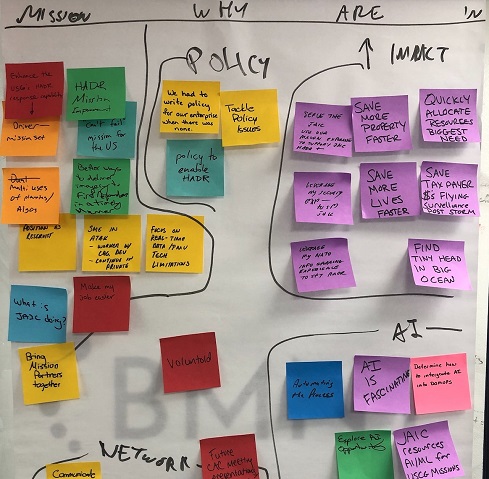
What it is: A way to quickly get a sense of people’s expectations for a meeting. Ask everyone to write down three reasons why they are there on Post-It notes, then place them up on a wall. Once everyone is done, give the group a few minutes to reorganize the Post-its. Usually they will group like responses together, then label them to create themes. This gives you a place to start the conversation about your goals and how they align with the team’s expectations.

When and why to use it: When you are convening a group in the early stages of a project, or when a team is doing a one-off activity. It provides useful feedback to you as a leader. You get to see what the team heard, not just what you said.

Image: BMNT Inc.
                                        Image: BMNT Inc.
 
Public brain #3: Ask the expert
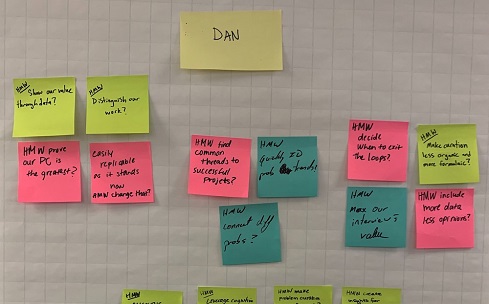
What it is: A way to capture the models, questions, and concerns of key personnel. Come up with key questions to which you need answers, then set a 30-minute timer. The team focuses on a single person who answers these questions, plus any follow-up questions that emerge. Key insights are captured on Post-It notes and placed on an easel sheet with the expert’s name written at the top.

When and why to use it: When you need to source critical information quickly. Experts tend to derail group conversations with unnecessary detail, and love to talk for too long about their areas of interest. This allows you to focus their contribution around key topics.

Image: BMNT Inc.
                                           Image: BMNT Inc.
 
Public brain #4: Impact/effort chart
What it is: A way to force a team to commit to next steps. Write down all the major ideas your team is considering, one idea per Post-It note. Draw a graph extending both up and to the right from the origin. Label the Y axis “Effort” and the X axis “Impact.” Ask the team to place each idea on this chart relative to the other ideas. Pick the top-left ideas for execution first, followed by the top-right. Consider whether any of the bottom-right or bottom-left ideas need to be carried forward, or if they can safely be eliminated without affecting your project.

When and why to use it: Toward the end of a meeting when you want to focus on implementation. This is the most important part of a meeting, when team members typically start to endlessly debate ideas. The impact/effort chart forces them to agree on relative merits as a group. The next steps appear almost obvious once this visual framework is adopted.

Image: BMNT Inc.
                                           Image: BMNT Inc.
 
Managers need lots of tools to unlock performance from their teams. This is especially true for IT leaders in matrix organizations. Public brains are one way to quickly build context in a diverse group. They are practical options to strengthen relationships, gather information, collect feedback, and build consensus.
 
About the Author
 
William Treseder is the Senior VP of Product at BMNT Inc., a Silicon Valley-based innovation consultancy and early-stage tech accelerator.
 

Sunday, 3 November 2019

As Jobs Are Automated, Will Men and Women Be Affected Equally?


I am writing this article while my baby daughter sleeps. Like all new parents, her dad and I have spent the last few months in a joy-filled, sleepy haze of getting to know her and imagining what her future might look like. This brings a new intensity, and a little more trepidation, to my role advising on the future of work. What will work look like for this generation of young women, especially as more and more of our roles are being automated — or even replaced — by artificial intelligence (AI)? And how can leaders ensure that AI does not lead to gender bias in their organizations? Recent research is beginning to answer these questions, and the outlook is mixed: on the one hand, women may be spared from the job disruptions men will face in the longer-term. On the other, the lack of gender diversity in AI-related jobs could be reflected in the tools that are created, affecting whether women are hired or promoted.

First, the impact of AI on work will be influenced by the distribution of women and men in particular jobs. While an AI tool may not be designed to replace the tasks of women or men in particular, many occupations are so skewed in their current distribution that waves of automation may be felt more by women, or by men, at particular times. Bureau of Labor Statistics data show that there’s an unbalanced gender distribution among the most common jobs in the U.S. today. Jobs such as elementary and middle school teachers, registered nurses, and secretaries and administrative assistants each comprise at least 80% women; while jobs such as truck drivers and construction laborers employ more than 90% men.

Because AI tools will tend to automate tasks, rather than whole jobs, many occupations will be affected unequally. While the gender distribution of occupations may shift over time, PwC has estimated that more women than men will be affected by job changes between now and the late 2020s. This disproportionate impact on women is based largely on the high number of women employed in clerical occupations: in the U.S., for example, 94% of secretaries and administrative assistants are women. These kinds of roles are being disproportionally affected by technological developments like automated assistants, and smarter email, calendar, and financial software.

This picture changes over the medium-term. As new AI capabilities develop, such as self-driving technologies, more men than women will be affected by job changes between the late 2020s and the mid 2030s. During those years, automation is predicted to lead to job losses in what are currently male-heavy industries, such as construction and transportation. Employers should be thinking about this job redistribution in advance, to help ensure that a wave of redundancies following technological change does not lead to a sudden worsening in organizational gender balance. This could mean slowing down job losses to enable the organization to adjust. Aiming for gender parity in those areas in which jobs are more secure, such as management roles, becomes all the more important.

Second, consider that women’s current representation in jobs related to AI is unequivocally poor. According to 2018 data from the World Economic Forum and LinkedIn, only 22% of jobs in artificial intelligence are held by women, with even fewer holding the most senior roles. This is an important disparity, because those who learn about, experiment with, and implement AI technologies will be creating the tools that organizations use on a day-to-day basis — and any unconscious biases baked into their decisions they make could have serious consequences. For example, more and more HR departments are using algorithms to help sift through resumes, conduct interviews, determine pay, and spot performance problems. These tools are often intended to be more objective than human decision-making, but they can easily go awry. For example, Amazon abandoned its AI recruitment tool after discovering that it showed preference for male over female candidates.

Leaders of organizations using AI tools can help prevent the use of gender-biased tools by encouraging diverse technical teams wherever possible. Having more women developing tools may help teams spot unintentional gender biases, like training an algorithm on historic data that reflects gender inequality in who is hired or promoted. Leaders should also regularly check the completeness of tests used to detect gender bias. That’s because a resulting tool can still produce different outcomes for women and men even when an algorithm has been trained without using gender as a data parameter. In the case of resumes, a gap between jobs or a longer period without promotions may be treated by an algorithm as negative indicators, but could be for reasons unrelated to work, such as a mother spending more time at home around the birth of children. A tool that gives fair advice about hiring, performance, promotion or pay based on resumes should provide the same answers about men and women of equal competence, without assuming that male and female resumes will always look the same.

What does this all mean for girls like my daughter, who will be entering the workforce in two decades or so? There are substantial risks to navigate in the coming years, especially when women are judged using tools built on data from the world as it is, rather than the world as it should be. Leaders should do their own checks to ensure that the AI tools that their organizations are using are helping to reveal female talent, rather than accidentally overlooking it.

At the same time, the under-representation of women in science and technology roles is occurring alongside an over-representation of women in the kinds of roles that require emotional intelligence and advanced communication skills, such as speech pathologists, preschool teachers, or occupational therapists, to name a few. As skills such as empathy and collaboration are among those that are hardest to recreate in AI tools, many of these occupations are likely to be safer from technological disruption. Looking ahead, one happy possibility from the rise of AI is that people’s ability to understand one another and work together may become more valued as technological tools overtake us in other areas. My optimism also has me wondering whether, as workers gravitate towards the safest roles, there may be greater gender balance in jobs that have traditionally been dominated by men or by women. If so, this opens a greater variety of choices — and the possibility of greater job satisfaction — for both our sons and our daughters.

Source: Harvard Business Review

About the Author
Emma Martinho-Truswell is the co-founder and Chief Operating Officer of Oxford Insights, which advises organizations on the strategic, cultural, and leadership opportunities from digital transformation and artificial intelligence.